Dr. Barnwell
Dr. Barnwell is the physician who delivers the devastating diagnosis of Alzheimer's disease to Allie Nelson and her husband Noah Calhoun, and later treats Noah after his stroke. He embodies the medical establishment's clinical perspective, which stands in stark contrast to the miraculous moments of lucidity that Noah's daily readings of the notebook sometimes produce. Though a competent and compassionate doctor, he ultimately cannot explain the inexplicable improvements in Allie's condition, and his role underscores the novel's central tension between scientific certainty and the possibility of miracles.
Diagnosis and Medical Authority
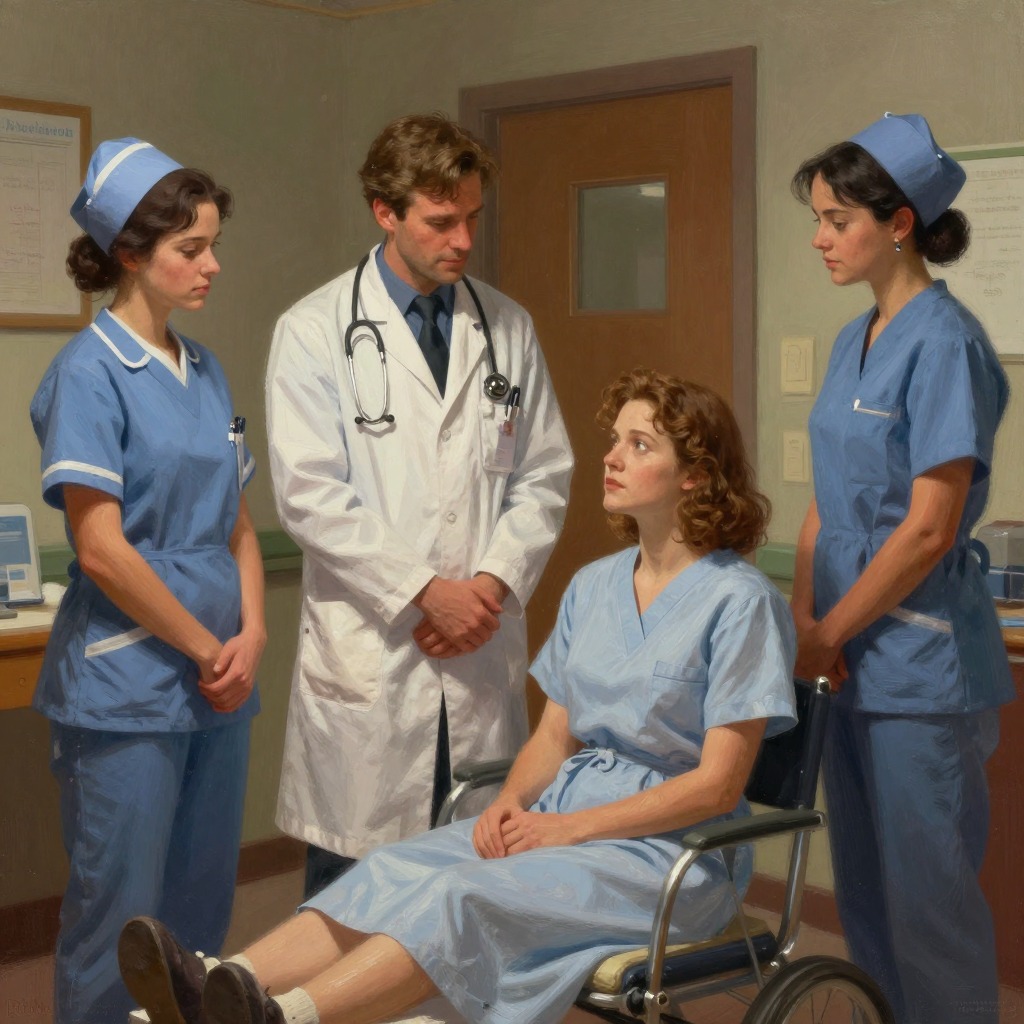
Dr. Barnwell first appears when Allie undergoes a series of tests after showing clear signs of cognitive decline—forgetting keys, misplacing items in strange places, and eventually becoming lost while driving near her home. After an hour-long appointment followed by another visit the next day, he calls both Allie and Noah into his office. Noah remembers his own hands shaking as they sat down. Dr. Barnwell begins with the words, "I'm so sorry to have to tell you this, but you seem to be in the early stages of Alzheimer's…" The diagnosis lands like a physical blow; Allie whispers "Oh, Noah . . . Noah . . ." and begins to sob on his chest. Dr. Barnwell continues his explanation, describing it as "a degenerative brain disorder affecting memory and personality" with "no cure or therapy" and no way to predict how fast it will progress. He admits, "I wish I knew more," and offers the grim prognosis that it "will grow worse with the passage of time." Noah, a hollow man with nothing to offer, can only hold his wife and rock her back and forth.
Limits of Medical Understanding
As Allie's disease progresses, she develops a pattern that defies Dr. Barnwell's clinical expectations. On some days, after Noah reads the notebook to her, her condition improves dramatically—her emotions and thoughts become normal, and only her memory is gone, as if she has amnesia rather than Alzheimer's. Four times, specialists travel from Chapel Hill to study her case, and four times they leave without understanding. Dr. Barnwell and his colleagues insist, "Alzheimer's does not work like this. With her condition, it's just not possible to have a conversation or improve as the day goes on. Ever." Yet Allie does improve, not every day and less frequently as time passes, but sometimes. Noah tells the doctors the reason—he knows it in his heart—but he is not believed. "You can't possibly understand it if you use only your science training and your books," he says, but they shake their heads. Dr. Barnwell, though a good man who finds the diagnosis hard to deliver, represents the limits of scientific medicine when confronted with the power of love and narrative.
Noah's Stroke and Recovery
Years later, after a day of reading to Allie and a week of normal routine, Noah suffers a stroke while sitting by his window watching the creek. He loses his sight and hears a train roaring in his head, and in his last conscious moments he pictures Allie lying in her bed, waiting for the story he will never read. He is unconscious on and off for days, hooked to machines with two bags of fluid hanging near the bed. Dr. Barnwell appears again, his face grim as he scans charts and adjusts machines, predicting "loss of speech, loss of movement, paralysis." But on a foggy morning, Noah's promise to Allie spurs his body back. He opens his eyes to a room full of flowers, presses the buzzer, and when Dr. Barnwell arrives thirty seconds later, Noah rasps, "I'm thirsty." Dr. Barnwell smiles broadly and says, "Welcome back, I knew you'd make it." The doctor's optimism, however, cannot undo the damage: the right side of Noah's body is permanently weakened, and he must learn a new, halting way of walking—"slow-shuffle, slide-the-right, slow-shuffle"—that turns every trip down the hall into an epic adventure.
Narrative Significance
Dr. Barnwell functions as a foil to Noah's faith in miracles. Where the doctor sees a disease that cannot be reversed, Noah sees a woman who sometimes, just sometimes, comes back to him after he reads their story. The nurses, who witness these moments daily, understand what the doctors cannot: "It's love—it's as simple as that," one nurse tells Noah. Dr. Barnwell's clinical pronouncements—the diagnosis, the prognosis, the predictions of paralysis—are all accurate by medical standards, yet they fail to capture the full truth of Allie and Noah's life together. His presence in the narrative anchors the story in the real, tragic facts of aging and disease, making the moments of miracle all the more powerful precisely because they are not explained away by science.